top of page


The Palm Cockatoo Breeding Habitat Restoration Project

Palm cockatoos (Probosciger aterrimus) are only found in Australia in the remote Cape York Peninsula.
There are fewer than 2,000 believed to be living in the wild due to poor reproductive rates and habitat destruction from land-clearing and climate change.
The palm cockatoo is Australia’s largest parrot by weight, and has the lowest reported breeding success of any species of parrot - the female palm cockatoo only lays one egg every 2 years.

Due to the large size of the Palm cockatoo they need very large nesting hollows that can only be accommodated in trees of around 300 years of age.
Wildfires and other extreme weather events have substantially reduced the number of these old-growth trees, and as such appropriate nesting hollows are scarce in the landscape.

People For Wildlife has partnered with renowned Palm Cockatoo expert Dr. Christina Zdenek, to research and ultimately create new nesting habitat for this endangered species. Together, we are, quantifying physical characteristics of hollows known to be used by palm cockatoos to determine why palmies select particular hollows.
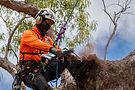
We are creating new Palm cockatoo breeding habitat by augmenting and modifying existing hollows to make them more appropriate for palm cockatoos, and creating new hollows by hollowing out sections of large fallen trees and hoisting them into the canopy. We are alos protecting known natural Palm cockatoo nests from fire by establishing fire breaks around trees containing hollows.
0
New artificial nests created
0
known Palm cockatoo hollows protected from wildfire

We are also:
-
Leveraging machine learning to create an algorithm that automatically and instantaneously detects palm cockatoo adult and chick calls in long-term soundscape recordings, to rapidly identify presence of this species and monitor nesting success.
-
Installing small, discrete nest cameras at known palm cockatoo nests to see what happens inside palmy nests and ultimately understand why nests fail.
-
Installing small temperature data loggers inside artificial hollows, and natural hollows used by palm cockatoos, to understand thermal regimes within these hollows and ensure the hollows we create closely match existing natural hollows.

Nesting success
In September 2025 an adult pair of palm cockatoo's laid an egg inside one of our artifical hollows. Our Apudthama land management team monitored the activity around the hollow from the ground, and our wildlife friendly cameras told the story from canopy. We captured nearly 8,000 images documenting the birds exploring, entering and leaving the hollows, providing crucial confirmation of nesting activity. These monitoring efforts allowed one of our team to capture an image of the fledgling on it's last day before leaving the hollow.
This is the first documented fledging of a palm cockatoo from an artificial hollow worldwide.


The Palm cockatoo breeding habitat restoration project is proudly supported by the Australian Geographic Society and the Queensland Government's Threatened Species Research Grant program (round 2) to enable us to begin the project


NEWS AND MEDIA


bottom of page